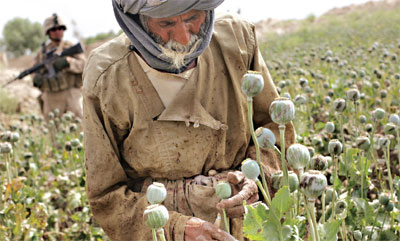
An Afghan drug lord received money in exchange for information from the C.I.A. or United States military. A poppy field in Afghanistan. DAVID GUTTENFELDER/ASSOCIATED PRESS
WASHINGTON - When Hajji Juma Khan was arrested and transported to New York in 2008, federal prosecutors described him as perhaps the biggest drug lord in Afghanistan, a shadowy figure who had helped keep the Taliban in business.
But what the government did not say was that Mr. Juma Khan was also a longtime American informer on the Taliban, Afghan corruption and other drug traffickers.
At the height of his power, Mr. Juma Khan was secretly flown to Washington for a series of clandestine meetings with C.I.A. and Drug Enforcement Administration officials in 2006.
Afghan drug lords have often been useful sources of information about the Taliban. But relying on them has also put the United States in the position of looking the other way as these informers ply their trade in a country that by many accounts has become a narco-state.
At first, Mr. Juma Khan, an illiterate trafficker in his mid-50s from the remote Nimroz Province, was a big winner from the American-led invasion. He rose to national prominence, taking advantage of a record surge in opium production after the invasion.
Briefly detained by American forces, he was quickly released, according to current and former American officials.
By 2004, Mr. Juma Khan had gained control over drug routes from southern Afghanistan to Pakistan’s Makran Coast, as well as overland routes through western Afghanistan to Iran and Turkey. He lavished bribes on all the warring factions, from the Taliban to the Pakistani intelligence service to the Karzai government, according to the officials.
In 2004, Robert B. Charles, then the assistant secretary of state for international narcotics and law enforcement, told Time magazine that Mr. Juma Khan was a drug lord “obviously very tightly tied to the Taliban.”
Such high-level concern did not lead to any action against Mr. Juma Khan. But Mr. Noorzai, one of his rivals, was lured to New York and arrested in 2005.
In a 2006 confidential report to the drug agency , an Afghan informer stated that Mr. Juma Khan was working with Ahmed Wali Karzai, the political boss of southern Afghanistan, to take control of the drug trafficking operations left by Mr. Noorzai. By then, Mr. Juma Khan had been working as an informer for the C.I.A. and the drug agency for several years, officials said.
According to people with knowledge of the case, along with tribal leaders in his region he was given a share of as much as $2 million to oppose the Taliban. The payments are said to have been made by the C.I.A. or the United States military.
The 2006 Washington meetings were an opportunity for both sides to determine whether they could cooperate even more.
“I think this was an opportunity to drill down and see what he would be able to provide,” one former American official said. While the C.I.A. wanted information about the Taliban, the drug agency wanted to know about other Afghan traffickers, as well as the supply lines through Turkey and Europe.
The relationship between the C.I.A. and the D.E.A. and Mr. Juma Khan continued for some time after the Washington sessions, officials say.
In fact, when the drug agency contacted him again in October 2008 to invite him to another meeting, he went willingly, even paying his own way to Jakarta, Indonesia, to meet with the agency, current and former officials said.
But this time, instead of enjoying fancy hotels and friendly talks, Mr. Juma Khan was arrested and flown to New York.
It is unclear why the government decided to go after Mr. Juma Khan. Some officials suggest that he never came through with breakthrough intelligence. Others say that he became so big that he was hard to ignore.
The Justice Department has used a 2006 narco-terrorism law against Mr. Juma Khan, one that makes it easier for American prosecutors to go after foreign drug traffickers who are not smuggling directly into the United States if the government can show they have ties to terrorist organizations.
But even some current and former American counternarcotics officials are skeptical of the government’s claims that Mr. Juma Khan was a strong supporter of the Taliban.
“He was not ideological,” one former official said. “He made payments to them. He made payments to government officials. It was part of the business.”
Now, plea negotiations are quietly under way. A plea bargain might keep many of the details of his relationship to the United States out of the public record.
By JAMES RISEN