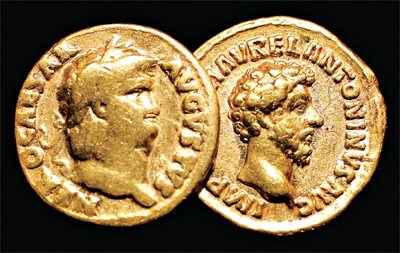
Glorious gold, so coveted throughout the centuries that people will
From Egyptian pharaohs to Roman emperors, medieval kings to Spanish conquistadors, Mughal princes to Chinese dynasties, and all the jewelry makers and coin minters who served them, humans have displayed an atavistic connection to the value of gold. The simple question is why. The simple answer, posited by a New York party designer: “Gold is warm. It is a color that makes you feel good,” David Monn told The Times.
And if you were smart enough to invest in what was referred to in antiquity as “tears of the sun” before the recent run-up in its price, you are probably feeling pretty good about your investing acumen. An ounce of gold has nearly doubled in value in the last two years, and its recent high was over $1,400 an ounce in October. But for all the news of “record gold prices,” the current cost is nowhere near a record once it is adjusted for inflation, as David Leonhardt, a Times economics columnist, recently pointed out.
The actual record was set 30 years ago, when the price of an ounce of gold hit $2,387, or about 70 percent higher than the $1,385 it closed at on November 30. “The notion that gold is more expensive than ever happens to fit with a larger narrative that also does not square with the facts ? namely, that inflation is an imminent threat,” Mr. Leonhardt wrote.
Inflation fears are being fueled by the policy pronouncement by the United States Federal Reserve that it would print $600 billion and pump it into the banking system.
That approach has James Grant, the author of “Money of the Mind” and the editor of the bi-monthly magazine Grant’s Interest Rate Observer, urging a return to a simpler time: “Let the economists gasp: The classical gold standard, the one that was in place from 1880 to 1914, is what the world needs now.
In its utility, economy and elegance, there has never been a monetary system like it,” Mr. Grant wrote in The Times. His argument is based on the principle that it would be easier to trust the market that would set a relative value for the dollar backed by gold, rather than a small army of Ph.D. economists working at the Federal Reserve who are currently responsible for setting monetary policy.
As Floyd Norris, a Times finance columnist, wrote, the soaring price of gold reflects “first and foremost a dismay at the current state of the world economy, and a conclusion that the elites who are running it do not know what they are doing.” There may be unseen dangers in faceless bureaucrats who make decisions that influence how the economy is managed, but those perils pale in comparison to the gold dealers in Iraq who are on the front lines in a sectarian struggle.
More than 40 people have been killed in jewelry store robberies in Iraq this year, and in October, men armed with rocket-propelled grenades attacked the largest gold market in Kirkuk, killing 10 people and injuring 10 others, The Times reported. Some gold dealers are closing shops early or operating on varying hours in case they are being watched. Some cannot imagine leaving the business and have resigned themselves to their fates.
“What will we do if we sell out?” asked Fahd al-Taie, 22, whose grandfather began selling gold in Karbala and whose father moved the business to Baghdad. “We don’t know anything else. Now, we await our death.” TOM BRADYFrom Egyptian pharaohs to Roman emperors, medieval kings to Spanish conquistadors, Mughal princes to Chinese dynasties, and all the jewelry makers and coin minters who served them, humans have displayed an atavistic connection to the value of gold.
The simple question is why. The simple answer, posited by a New York party designer: “Gold is warm. It is a color that makes you feel good,” David Monn told The Times. And if you were smart enough to invest in what was referred to in antiquity as “tears of the sun” before the recent run-up in its price, you are probably feeling pretty good about your investing acumen. An ounce of gold has nearly doubled in value in the last two years, and its recent high was over $1,400 an ounce in October.
But for all the news of “record gold prices,” the current cost is nowhere near a record once it is adjusted for inflation, as David Leonhardt, a Times economics columnist, recently pointed out. The actual record was set 30 years ago, when the price of an ounce of gold hit $2,387, or about 70 percent higher than the $1,385 it closed at on November 30.
“The notion that gold is more expensive than ever happens to fit with a larger narrative that also does not square with the facts - namely, that inflation is an imminent threat,” Mr. Leonhardt wrote. Inflation fears are being fueled by the policy pronouncement by the United States Federal Reserve that it would print $600 billion and pump it into the banking system. That approach has James Grant, the author of “Money of the Mind” and the editor of the bi-monthly magazine Grant’s Interest Rate Observer, urging a return to a simpler time: “Let the economists gasp: The classical gold standard, the one that was in place from 1880 to 1914, is what the world needs now. In its utility, economy and elegance, there has never been a monetary system like it,” Mr. Grant wrote in The Times.
His argument is based on the principle that it would be easier to trust the market that would set a relative value for the dollar backed by gold, rather than a small army of Ph.D. economists working at the Federal Reserve who are currently responsible for setting monetary policy.
As Floyd Norris, a Times finance columnist, wrote, the soaring price of gold reflects “first and foremost a dismay at the current state of the world economy, and a conclusion that the elites who are running it do not know what they are doing.” There may be unseen dangers in faceless bureaucrats who make decisions that influence how the economy is managed, but those perils pale in comparison to the gold dealers in Iraq who are on the front lines in a sectarian struggle.
More than 40 people have been killed in jewelry store robberies in Iraq this year, and in October, men armed with rocket-propelled grenades attacked the largest gold market in Kirkuk, killing 10 people and injuring 10 others, The Times reported. Some gold dealers are closing shops early or operating on varying hours in case they are being watched. Some cannot imagine leaving the business and have resigned themselves to their fates.
“What will we do if we sell out?” asked Fahd al-Taie, 22, whose grandfather began selling gold in Karbala and whose father moved the business to Baghdad. “We don’t know anything else. Now, we await our death.” TOM BRADY