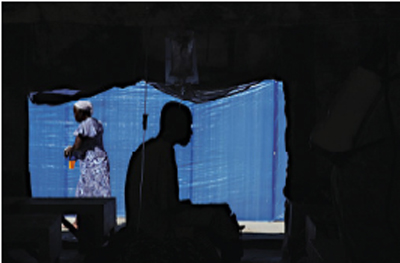
Pandemics have a long and meandering life. The current one, now in Haiti, hit Peru years ago. Cholera patients in Port-au-Prince.
If United Nations peacekeepers from Nepal are going to be blamed for bringing cholera to Haiti, it’s important to remember that the blame game for pandemics eventually involves everyone.
For example, cholera has laid waste to New York City several times. The first time, in 1832, New Yorkers blamed Canada. The last time, in 1866, they blamed the Irish, some of whom were sneaking ashore from quarantined ships.
Epidemics often inspire a search for scapegoats. Thousands of Haitians are being treated for cholera.
In this cholera pandemic — the seventh since the first recorded one in 1816 — one strain of the bacteria reached the American hemisphere in 1991, probably in an Asian freighter dumping its bilge tanks in a Peruvian harbor. When it reached the Mexican highlands a few months later, South American cocaine smugglers were suspected.
Haitians believe Nepalese caused a deadly outbreak.
Now, more than 1,000 Haitians have died and cholera experts expect the disease to persist there for months or years. Some of these experts concede that the Nepalese soldiers are the most likely suspects. Nepal had an outbreak in August, from the strain that is now in Haiti.
Angry Haitian crowds have already stoned Nepalese vehicles and the peacekeepers have shot back.
“Naming individual countries is not productive,” said Dr. Scott F. Dowell, chief of the response to the Haitian epidemic at the United States Centers for Disease Control and Prevention. “We’re focused on this really unacceptable number of deaths.”
Scapegoating has a long and ignoble tradition in historic pandemics. A famous example comes from Hispaniola, the island whose western half Haiti now occupies. Columbus’s sailors are assumed to have caught syphilis from the Indian population there in 1492.
Some of those sailors fought at the 1494 siege of Naples, and the devastating mystery disease that broke out among brothel visitors there was first called the Neapolitan Curse.
Soon, according to “The Prostitute’s Pupil,” a popular history of syphilis, the Italians were calling it the French pox, the French were calling it the Italian pox, the Dutch were calling it the Spanish itch, the Russians were calling it the Polish disease and the Turks were calling it the Christian disease.
Eventually it was given the Latin name Morbus gallicus, as in Gaul, so the French were stuck with the blame. But most scientists now believe that it was a New World disease, the only revenge aboriginal Americans got for the smallpox, measles, chickenpox, plague and tuberculosis that Columbus, Cortez and Pizarro were destined to visit on them.
Experts are divided over whether cholera will now spread throughout the Dominican Republic, which shares Hispaniola with Haiti. Dr. David M. Olson, a medical adviser to Doctors Without Borders, called that “pretty likely.” Dr. Dowell of the C.D.C. said he thought that the republic has “good enough water and sanitation to keep it from taking hold.”
No other Caribbean country is as vulnerable as Haiti, where more than a million people now live in tent camps and rainfall leaves them wading through a deadly brew of mud and feces.
In the worst imaginable case, Dr. Dowell said, the epidemic will stop only after infecting all 10 million Haitians. Probably only a quarter will get watery diarrhea, and most of those can be saved with prompt oral or intravenous rehydration.
But even if the fatality rate is pushed down to 1 percent — less than half its current rate — that could still mean up to 25,000 deaths.
None of that has to happen, insisted Dr. Fred Gerber, Haiti director for Project Hope, which has brought a team of cholera experts from Bangladesh to coach Haitian doctors.
The key, he said, is teaching people to avoid untreated water, and to start rehydration at the first sign of diarrhea. “It’s the people who wait too long that end up dying,” he said.
There is much about the disease that scientists admit not knowing.
The bacteria first emerged from the Ganges Delta in 1816, but light concentrations can be found in many places. They cling to copepods, tiny waterborne crustaceans, and outbreaks in Bangladesh have been slowed by simply pouring water through sari cloth to filter the copepods out.
They can infect shellfish and sicken just a few people or can, for unclear reasons, suddenly explode, as they did in the Artibonite River in Haiti.
And an epidemic can suddenly crash. It may happen when enough survivors have partial immunity, or with a change in weather and water conditions, or because a bacteria-killing virus has its own growth explosion.
Whatever the reason, experts hope that it happens soon.