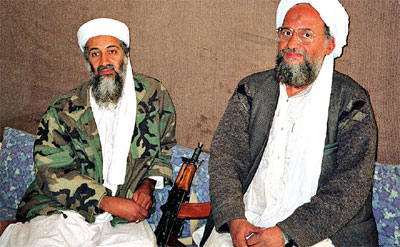
Ayman al-Zawahri, right, seen here with Osama bin Laden, has been trying to link the pro-democracy uprisings in the Middle East to the jihadist movement.
WASHINGTON - Al Qaeda and the movement it has spawned are unlikely to be immediately handicapped by the killing of Osama bin Laden, who by most accounts has long been removed from managing terrorist operations.
But the death of the founder and spiritual leader of the global terrorist network may further undercut the appeal of the violent extremism Bin Laden stood for.
“ It’s very important symbolically,” said Audrey Kurth Cronin, who studies terrorism at the National War College. “But as far as Al Qaeda is concerned, Bin Laden’s practical importance is nothing like it was at the time of the September 11 attacks.”
Ayman al-Zawahri, long the second in command in Al Qaeda and Bin Laden’s most likely successor, released five recordings between January and April trying to link the uprisings across the Arab world to the jihadist inspiration behind the 2001 attacks.
But the jihadist battle cry has not been particularly relevant to the uprisings, and Mr. Zawahri even apologized in his messages for being behind on developments in the Arab world: a result of being on the run, he said. Mr. Zawahri’s effort to sell Al Qaeda’s ideology as the answer to the problems of the Middle East will become even harder with Bin Laden’s death.
A former jihadist who fought with Bin Laden in Afghanistan, Mohammad Omar Abdel Rahman, said the Qaeda founder had not led the group for the last 10 years. “He was always a symbol,” said Mr. Abdel Rahman, 38 . “But as a movement, he was unable to lead and manage as he was being pursued so closely.”
Of Bin Laden’s death, he said, “People will feel it in their heart, but as far as action goes, it will have no impact.”
If the impact of Bin Laden’s May 2 death in Pakistan is limited, that is in part because of his success in creating a decentralized global movement with groups often linked by little more than a shared ideology. Al Qaeda affiliates are based in Yemen, North Africa and Somalia and have taken on a far more prominent role , including attacks aimed at the United States and Europe.
“The transition that the Middle East is going through at the moment will be a testing ground whether these ideas will survive, will come back with a vengeance or will cease to be relevant,” said Nelly Lahoud, a senior associate at the Combating Terrorism Center at the United States Military Academy. “Will the new emerging regimes deliver something meaningful in the Muslim world?”
Counterterrorism officials now are watching to see whether groups such as Al Qaeda in the Arabian Peninsula are distracted by the power struggle at home or move to fill the media vacuum left by Bin Laden’s death. The American-born militant cleric Anwar al-Awlaki, now hiding in Yemen, could take on greater prominence.
In the coming weeks counterterrorism officials will be on the lookout for new attacks designed by Mr. Zawahri and his other followers to show their continuing potency.
A classified American document describes a reported Qaeda plan to detonate a nuclear weapon if and when Bin Laden were captured or killed. Officials believe the group has no such weapon, but they are concerned that Bin Laden’s death could be a pre-arranged signal for setting a plot in motion.
“The question is how quickly Zawahri and the remnants can try to prove their relevance with new operations,” said Bruce Hoffman, a terrorism expert at Georgetown University in Washington. “Their incentive is all the greater now.”
If Bin Laden was Al Qaeda’s ideological leader, Mr. Zawahri, 59, has been its organizational brains. But he is viewed as something of a professorial scold, caught up in local issues and feuds . Others, however, believe that Mr. Zawahri’s organizational skills will be more necessary than charisma at a time when Al Qaeda’s core needs to be held together.
Even as the United States carried out its decade-long hunt for Bin Laden, his support among Muslims in many countries has tumbled, often after terrorists killed Muslim civilians. In Pakistan, for instance, a Pew Research survey shows that confidence in Bin Laden fell from 46 percent in 2003 to 18 percent last year.
Mr. Abdel Rahman, a son of the blind Egyptian sheik who is serving a life sentence for his role in plotting to attack New York City landmarks, said Bin Laden would continue to inspire others. “The United States killed him, but left everything there that he was fighting for,” he said.
In Afghanistan, a member of the Taliban’s ruling council insist ed Bin Laden’s death would not matter . “ The mujahedeen are silent to see what the leadership will announce,” he said. “But after the time of silence there will be a time of payback.”
By SCOTT SHANE
and ROBERT F. WORTH