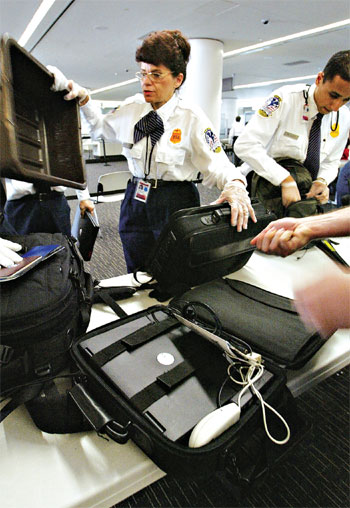
U.S. Customs officers hunt for illegal activity by copying laptops and cellphones. Critics say this compromises sensitive information. JUSTIN SULLIVAN/GETTY IMAGES
At Dulles airport near Washington, Customs and Border Protection officers who staff the passport booths make quick decisions about travelers. They ask questions (often across language barriers) and watch computer displays that don’t go much beyond name, date of birth and codes for a previous customs problem or an outstanding arrest warrant.
The officers are supposed to pick out the possible smugglers, terrorists or child pornographers and send them to secondary screening.
This secondary screening is where concerns have developed about invasions of privacy, for the most complete records on the travelers may be the ones they are carrying: their laptop computers full of professional and personal e-mail messages, photographs, diaries, legal documents, tax returns, browsing histories and other windows into their lives far beyond anything that could be stuffed into a suitcase .
Those revealing digital portraits can be immensely useful to inspectors, who now hunt for criminal activity and security threats by searching and copying people’s hard drives, cellphones and other electronic devices .
Digital inspections raise constitutional questions about how robust the guarantee of the Fourth Amendment of the United States Constitution should be “against unreasonable searches and seizures” on the border, especially in a time of terrorism. A total of 6,671 travelers had electronic gear searched from October 1, 2008, through June 2, 2010, just a tiny percentage of arrivals.
One regular target is Pascal Abidor, a New York-born student getting his Ph.D. in Islamic studies, who reported being frisked, handcuffed, taken off a train from Montreal and locked for several hours in a cell last May, apparently because his computer contained research material in Arabic and news photographs of Hezbollah and Hamas rallies. He said he was questioned about his political and religious views, and his laptop was held for 11 days.
Another is James Yee, a former Muslim chaplain at the Guantanamo Bay prison, who gets what he wryly calls a “V.I.P. escort” whenever he flies into the United States. In 2003, Mr. Yee was jailed and then exonerated by the Army after he had conveyed prisoners’ complaints about abuse, urged respect for their religious practices and reported obscene anti-Muslim caricatures being e-mailed among security staff.
Years later, he evidently remains on a “lookout” list. A federal agent greets Mr. Yee’s incoming plane, then escorts him to secondary screening.
Customs won’t comment on specific cases. In general, “we’re looking for anyone who might be violating a U.S. law and is posing a threat to the country,” a spokeswoman said.
Yet the agency’s practice of copying data has created a sense of risk among certain travelers, including lawyers who need to protect attorney-client privilege, business people with proprietary information, researchers who promise their subjects anonymity and photojournalists who may pledge to blur a face to conceal an identity. Some are now minimizing data on computers they take overseas.
“I just had to do this myself when I traveled internationally,” said Catherine Crump, a lawyer for the American Civil Liberties Union who is the lead attorney in a lawsuit challenging the policy on behalf of Mr. Abidor, the National Association of Criminal Defense Lawyers and the National Press Photographers Association.
During a week in Paris, she did legal work for clients, which she could not risk the government seeing as she returned.
“It’s a pain to get a new computer,” she said, “wipe it completely clean, travel through the border, put the new data on, wipe it completely clean again.”
The A.C.L.U. doesn’t want customs not to search, Ms. Crump said, but just wants the courts to require reasonable suspicion, as the Supreme Court did in 1985 .
The court distinguished intrusive inspection from “routine searches” on the border, which “are not subject to any requirement of reasonable suspicion, probable cause, or warrant.” Laptop searches should be considered “nonroutine,” Ms. Crump argues.
Mr. Abidor no longer takes the train home from Montreal. He doesn’t want to be stranded at the border . So in January his father drove up from New York to get him for vacation. The men were ordered to a room and told to keep their hands on a table while customs officers spent 45 minutes searching the car, and possibly the laptop, Mr. Abidor said. “I was told to expect this every time.”
By DAVID K. SHIPLER