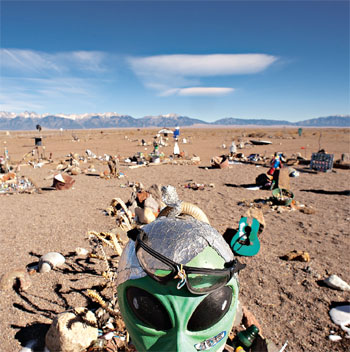
Scientists fervently search the cosmos for signs of life. Here on Earth, a campground with an alien theme in Colorado’s San Luis Valley.
Gregarious by nature, humans hate to feel left out. And if there’s a party going on somewhere, anywhere, even light years away, we would prefer to know about it. But despite a half-century of radio telescopes rummaging through the heavens for intelligent blips and beeps, not one galactic social network has friended the Earth.
The cosmic silence has not discouraged scientists, however. Efforts to find and theorize about extraterrestrial life ? whether pond scum or saucer men - are accelerating, spurred on by some intriguing new discoveries.
Starting with real estate: when astrophysicists found evidence of extrasolar planets in 1995, it was through calibrating the minute wobble of stars disrupted by the pull of planets, thought to be gaseous giants like Jupiter. Lately, more proof has been detected by the $600 million Kepler space telescope. In February, NASA reported the discovery of 1,235 potential new planets, some of them believed to be rocky, like Earth. Most also appear to be as searing as Mercury or as icy as Pluto.
“Within the next few years,” Ray Jayawardhana, an astronomer at the University of Toronto, wrote in The Times, “astronomers expect to find dozens of alien earths that are roughly the size of our planet. Some of them will likely be in the so-called habitable zone .”
Meanwhile, the very definition of the habitable “Goldilocks” zone, where the conditions for life are “just right,” is being reconsidered. Life has been found in deep-sea volcanic vents and the frozen dry valleys of Antarctica. And as reported in December, a bacterium from the bottom of Mono Lake in California can thrive on a diet of arsenic, which was long thought to be toxic to life, and without phosphor us, which was considered essential.
“It gives us food for thought about what might be possible in another world,” Gerald Joyce, a molecular biologist at the Scripps Research Institute in La Jolla, California, told The Times.
So while a $2.5 billion robot craft named Curiosity is expected to depart for Mars this fall, some scientists believe the search for life could also focus on worlds like Titan, the Saturnian moon draped in icy methane slush.
While a far cry from Mr. Spock, methane-infused microbes would have a profound effect on human awareness by suggesting that life is common in the universe. But what of an advanced civilization? SETI, the Search for Extraterrestrial Intelligence, is far from defunct, despite its zero success rate. In coming years, the Allen Telescope Array in California may expand into a network of 350 linked radiotelescope dishes, enabling a far more comprehensive search of distant star systems.
Scientists are already considering the ramifications of messages - or visits - from sentient beings based light years from Earth.
“Would there be social unrest, even panic?” wrote the cosmologist Paul Davies in “The Eerie Silence: Renewing Our Search for Alien Intelligence.” “How would the world’s leaders react? Would the news be regarded with fear or wonderment?”
Last year, scientists urged the United Nations Office for Outer Space Affairs to formulate a plan for welcoming hypersmart extraterrestrials. Mazlan Othman, the Malaysian astrophysicist who runs the office, was unmoved.
She told The Times: “I am not the ambassador to aliens.”
KEVIN DELANEY