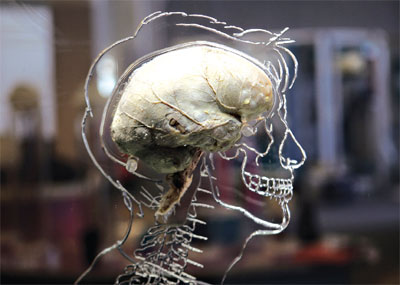
The human brain evolved to store information, but in recent times it has been delegating the task to technology. MATT CARDY/GETTY IMAGES
Remembering where to find food while navigating the forest and avoiding the local saber tooth tiger was once a matter of survival. So the human brain evolved to store information accordingly. But in more recent centuries, technology - from Gutenberg’s printing press to Jobs’s iPad - has been doing the work for us.
That may explain why many of us can’t remember passwords, phone numbers or where we left our car keys. And why chimps outscore humans in some types of memory tests.
Happily, some forward - and sometimes backward - looking experts are seeking ways to improve memory.
With just a little help from a German supermodel.
In his book “Moonwalking With Einstein: The Art and Science of Remembering Everything,” Joshua Foer writes, “Evolution has programmed our brains to find two things particularly interesting, and therefore memorable: jokes and sex - and especially, it seems, jokes about sex.”
In Mr. Foer’s case, he learned to remember obscure facts and details by associating each with a familiar place or room or, better still, a humorous and titillating image. One such mental picture was Claudia Schiffer swimming in a vat of cottage cheese. The technique proved so unforgettable that it carried Mr. Foer, a guy who couldn’t even remember his girlfriend’s birthday, into the finals of the 2006 U.S.A. Memory Championships after only a year of training.
And as Maureen Dowd wrote in The Times, all it took were “a few tricks and a good erotic imagination.”
The technique isn’t new, however . Mr. Foer’s memory tutors were inspired by the ancient Romans and Peter of Ravenna, an Italian jurist who wrote in the 15th century that “if you want to remember quickly, dispose the images of the most beautiful virgins into memory places.”
Those with bad memories and hopelessly chaste minds may find other help, especially as aging baby boomers grow willing to pump cash into their fading memories. Google “memory aid” and a plethora of tips, techniques, seminars and herbal supplements will pop up.
One technique, neurofeedback, purports to use computer technology to redirect brainwaves. It is expensive and controversial, but its proponents claim that it makes “lasting changes in attention, memory, mood, control, pain, sleep and more,” The Times reported. Others dismiss it. William E. Pelham Jr., director of the Center for Children and Families at Florida International University, told The Times that he considered it “crackpot charlatanism.”
Another memory enhancer may offer greater promise. Researchers in Israel and New York reported this month that rat recall was bolstered by injections of PKM-zeta, an enzyme believed to be involved in the storing of memories.
Despite the success of the studies, a fully approved drug to enhance memory may still be far off, the experts stress. In the meantime, there is a simpler way to prop up the memory centers of aging brains : keep working. As The Times reported last year, a study of older people in the United States and 12 European countries suggested that memories decline faster with earlier retirement.
Or as Pablo Casals, the virtuoso cellist who could remember musical compositions into his 90s, once declared, “To retire is to die.”
KEVIN DELANEY