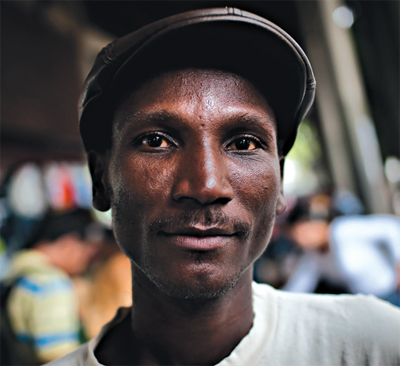
Venezuela welcomed Haitians, like Joseph Dieu Seul after January’s devastating earthquake
By SIMON ROMERO
CARACAS, Venezuela - This country is in the throes of an immigration puzzle. While large numbers of the middle class head for the exits, hundreds of thousands of foreign merchants and laborers have put down stakes here in recent years.
The influx may seem surprising. On this booming continent, oil-rich Venezuela is South America’s only shrinking economy this year. Officials are rationing hard currency.
Government takeovers of private businesses are increasing. One prominent financial analyst recently had just two words of advice for investors here: “Run away.” But in the bazaar in this city’s old center, merchants murmur in Arabic, Urdu and Hindi. Haitians pushing ice cream carts chatter in Creole.
Street vendors selling DVDs call out in Colombian-accented Spanish. Sip coffee in Naji Hammoud’s clothing shop, and the outlook is optimistic. “There’s money in the street, whether the price of oil is $8 a barrel or $80,” said Mr. Hammoud, 36, who came here from Lebanon a decade ago. “I could have moved to Europe, Germany, someplace, and done fine, but I would have been someone’s employee. Here, I’m my own boss.”
The opposing tides reflect the country’s increasingly polarized nature. The government of President Hugo Chavez, who recently declared an “economic war” against the “bourgeoisie,” has expropriated 207 private businesses this year , prompting many to seek safer havens elsewhere. “I feel like I can finally breathe again,” said Ivor Heyer, 48, the owner of a boat manufacturing company, who recently moved his entire operation to Colombia, creating more than 100 jobs there.
“I’ve gone from a country where fear is constant over crime and state takeovers to a place that actually welcomes companies involved in something other than oil.” Many immigrants continue to arrive on tourist visas and overstay their visits, drawn by incomes that are still higher than those in some of Venezuela’s neighbors and by a broad array of social welfare programs for the poor.
“One can live with a little bit of dignity here, at least enough to send money home now and again,” said Etienne Dieu-Seul, 35, a Haitian street vendor, who moved here a month before January’s devastating earthquake in Haiti.
As many as four million immigrants have come here from Colombia, according to Juan Carlos Tanus, director of the Association of Colombians in Venezuela. And some continue to arrive, despite the protracted recession here and the recent strides Colombia has made in growing its economy and fighting the rebel groups that have plagued it for so long.
“There’s work in Venezuela for those who want it,” said Arturo Vargas, 39, a Colombian laborer who moved to Caracas last year,
finding jobs as a watchman and at a chicken-processing plant. “This place isn’t perfect, but it’s better than what I left behind.” The influx is driven in part by Venezuela’s long tradition of lenient immigration policies ? dating at least from the years after World War II ? and by the importance of oil.
Even during times of fluctuating oil prices and institutional disarray, revenues from petroleum exports give Venezuela a cushion against the wrenching crises that have jolted its neighbors in the past. Oil money also allows for a broad assortment of imports, creating a large consumer society and opportunities for people to sell things in it.
More than 50,000 Chinese have settled in the country, working largely as shopkeepers. Thousands of merchants and their families from Lebanon, Syria and Jordan have also arrived in recent years, extending a tradition that dates back more than a century . The Middle Eastern community here is big enough to support one of South America’s largest mosques, across the street from a sprawling mission for Lebanese Maronite Christians.
While economic reasons are paramount for immigrants, ideology also plays a small role in attracting some immigrants here. Some from the Middle East find affinities with Venezuela’s contentious policies toward Israel.
Those same policies, combined with fears over violence and economic shifts, have factored into the decisions of thousands of Jews here to emigrate. As with Venezuela’s immigrants, precise figures on Venezuela’s emigrants are unavailable, but Ivan de la Vega, a sociologist here, puts their number in the hundreds of thousands .
In a twist, many of the emigrants are the children or grandchildren of immigrants who came to Venezuela during its long postwar boom. Spain and Portugal, which offer citizenship to descendants of immigrants, have absorbed many Venezuelans. Neighbors like Panama and Colombia, seeking to lure Venezuelan business owners, are welcoming others.
“It was not an easy decision, but it was necessary,” said Esther Bermudez, who recently moved to Montreal. She owns Mequieroir.com, a Web site that offers services for Venezuelans planning to emigrate (its name means “I want to leave”), and she said visits to the site climbed nearly 50 percent this year, to 80,000 a day. The new arrivals are not immune to Venezuela’s problems, confronting issues like restrictions on sending money abroad and rampant crime.
Assailants near Caracas killed one Chinese laborer in September by dousing him with gasoline and burning him alive, according to local news reports. In separate cases in October, kidnappers abducted two Chinese women - one 19, the other 38 ? on the same day. (According to the United States State Department, Venezuela is in the top five for per capita murder rates in the world.) Still, that has not deterred the many new arrivals.
“This is a crazy place, not for families but fine for a single man like me,” said Subash Chand, 25, who moved here a year ago from the northern state of Haryana, in India, to manage a shop in downtown Caracas. “There’s danger and excitement here every day,” Mr. Chand said. “Within that mixture,” he added, “there’s money.”