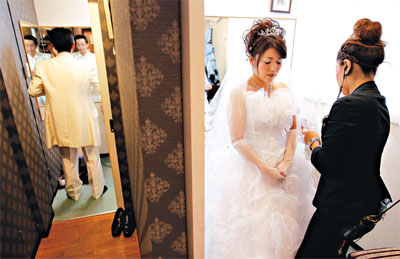
Japanese merchants are trying to attract customers with everlower prices. Some wedding ceremonies now cost a tenth of what they were a decade ago.
By MARTIN FACKLER OSAKA
Japan - Few nations in recent history have seen such a striking reversal of economic fortune as Japan. The original Asian success story, Japan rode one of the great speculative stock and property bubbles of all time in the 1980s to become the first Asian country to challenge the long dominance of the West.
But the bubbles popped , and Japan fell into a slow but relentless decline. For nearly a generation, the nation has been trapped in low growth and deflation, a corrosive downward spiral of prices. Now, as the United States and other Western nations struggle to recover from a debt and property bubble of their own, Western economists are warning of “Japanification” ? of falling into the same deflationary trap of collapsed demand that occurs when consumers refuse to consume, corporations hold back on investments and banks sit on cash.
It becomes a vicious, self-reinforcing cycle: as prices fall further and jobs disappear, consumers tighten their purse strings even more and companies cut back on spending and delay expansion plans. “The U.S., the U.K., Spain, Ireland, they all are going through what Japan went through a decade or so ago,” said Richard Koo, chief economist at Nomura Securities. Deflation has left a deep imprint on the Japanese, breeding generational tensions and a culture of pessimism, fatalism and reduced expectations.
While Japan remains prosperous in many ways, it faces an increasingly grim situation. For many people under 40, it is hard to grasp just how far this is from the 1980s, when a mighty ? and threatening ?“Japan Inc.” seemed ready to obliterate whole American industries, from automakers to supercomputers. Today, Japan’s economy remains the same size it was in 1991: a gross domestic product of $5.7 trillion at current exchange rates.
During the same period, the United States economy doubled in size to $14.7 trillion, and this year China overtook Japan to become the world’s No. 2 economy. Companies and individuals have
lost the equivalent of trillions of dollars in the stock market, which is now just a quarter of its value in 1989, and in real estate, where the average price of a home is the same as it was in 1983.
And the future looks even bleaker, as Japan faces the world’s largest government, a shrinking population and rising rates of poverty and suicide. But perhaps the most noticeable impact here has been Japan’s crisis of confidence. A nearly arrogant pride has been replaced by a fear of the future, and an almost stifling air of resignation. Japan seems to have pulled into a shell.
Its once voracious manufacturers now seem prepared to surrender industry after industry to hungry South Korean and Chinese rivals. Japanese consumers, who once flew to Manhattan and Paris for shopping, stay home more often now, saving their money for an uncertain future. A new frugality is apparent among a generation of young Japanese. They refuse to buy expensive items like cars or televisions, and fewer study abroad. The pessimism is most visible among its young men, who are widely derided as “herbivores” for lacking their elders’ willingness to work long hours, or even to succeed in romance. “The Japanese used to be called economic animals,” said Mitsuo Ohashi, former chief executive officer of the chemicals giant Showa Denko.
“But somewhere along the way, Japan lost its animal spirits.” The classic explanation of the evils of deflation is that it makes individuals and businesses less willing to use money, because the rational way to act when prices are falling is to hold onto cash, which gains in value. But in Japan, nearly a generation of deflation has had a much deeper effect . It has bred a deep pessimism about the future and a fear of taking risks that make people instinctively reluctant to spend or invest, driving down demand - and prices - even further.
“A new common sense appears, in which consumers see it as irrational or even foolish to buy or borrow,” said Kazuhisa Takemura, a professor at Waseda University in Tokyo who has studied the psychology of deflation. Economists said one reason deflation became self-perpetuating was that it pushed companies and individuals to survive by cutting costs and selling what they already owned, instead of buying new goods or investing.
“Deflation destroys the risk-taking that capitalist economies need in order to grow,” said Shumpei Takemori, an economist at Keio University in Tokyo. “Creative destruction is replaced with what is just destructive destruction.” Merchants have gone to extremes to coax shell-shocked shoppers into spending again. But this often takes the shape of price wars that end up only feeding Japan’s deflationary spiral. Even marriage ceremonies are on sale, with discount wedding halls offering weddings for $600 ? less than a tenth of what ceremonies typically cost here just a decade ago.
In Osaka, Japan’s third-largest city, merchants recently held a deeply discounted sale, with disappointing results. “It’s like Japanese have even lost the desire to look good,” said Akiko Oka, 63, a clerk in a small apparel shop. After years of complacency, Japan appears to be waking up to its problems. But for many Japanese, it may be too late. Yukari Higaki, 24, said she saves as much money as she can by buying her clothes at discount stores, making her own lunches and forgoing travel abroad. She said that while her generation still lived comfortably, she and her peers were always in a defensive crouch, ready for the worst.
Hisakazu Matsuda, president of Japan Consumer Marketing Research Institute, calls young Japanese the consumption-haters. He estimates that by the time this generation hits their 60s, their frugality will have cost Japan $420 billion in lost consumption. “There is no other generation like this in the world,” he said. “These guys think it’s stupid to spend.” Ms. Higaki, who works part time at a furniture store, said, “We are the survival generation.